Contact
 Gallery
 Call
A facelift in your 40s makes sense when skin along the jawline and upper neck has started to loosen and fold, and injectables no longer correct it. It does not make sense when the main change is lost volume or fine lines, because surgery lifts tissue and does not replace what has thinned. For many women in their 40s, the right first operation is a mini facelift, and for others the right answer is to wait.
Most women notice the first shifts in the lower face. The line of the jaw softens. A small pocket of skin starts to gather just in front of the chin. The crease from the nose to the corner of the mouth deepens. You may also see fullness under the chin that was not there at 35.
Two separate processes cause these changes. The cheeks lose some of their volume, so tissue that once sat high slides lower. At the same time, the skin and the supporting layer beneath it lose some of their recoil and start to stretch. Our post on what causes jowls walks through that process in more detail.
The distinction matters because each process has its own fix. Volume loss responds to fillers or fat. Loose skin and sagging support tissue respond to surgery.
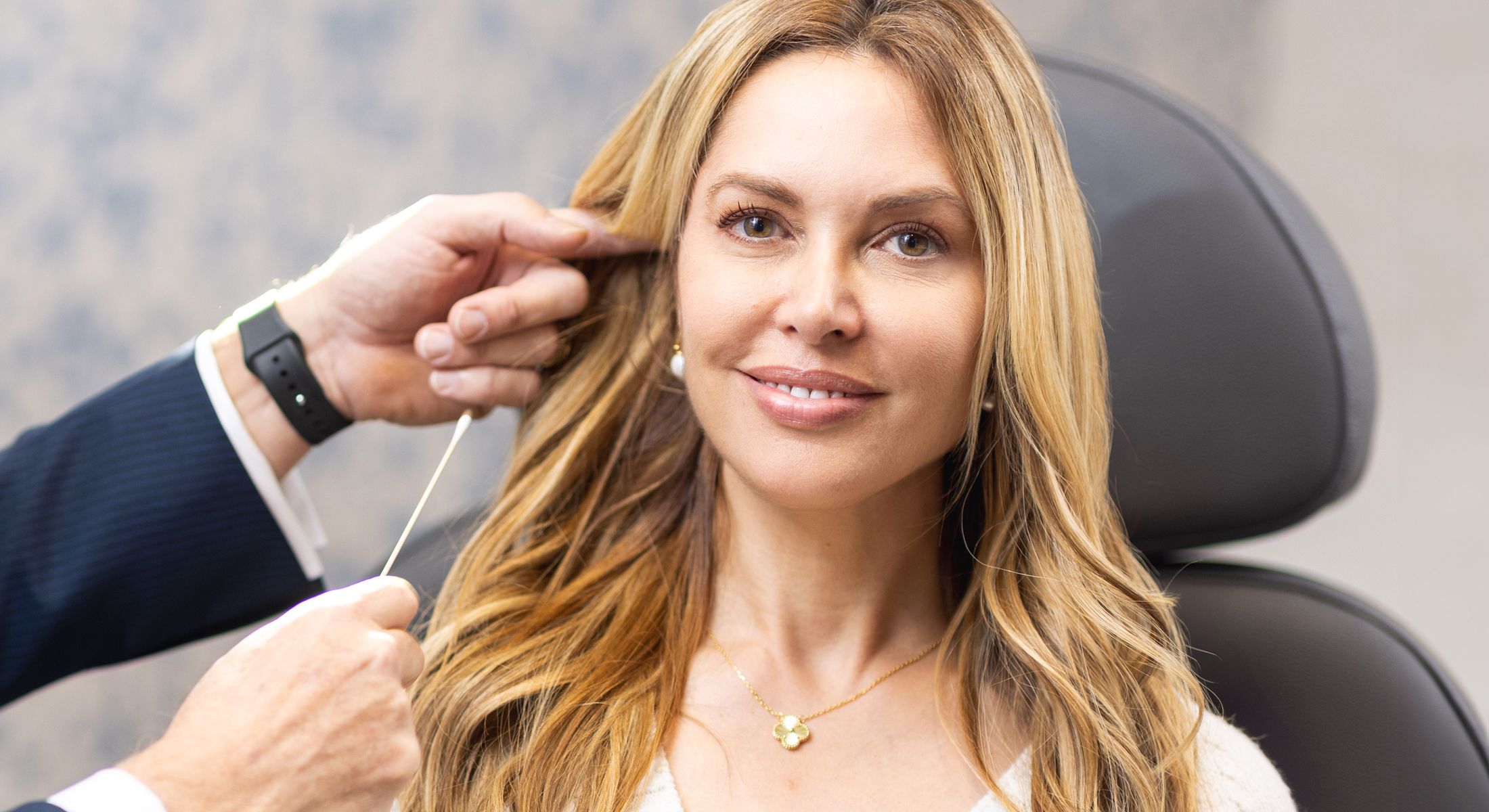
Surgery earns its place when you can see skin excess, not only shadows. A quick check at home: look straight into a mirror, then place your fingertips in front of your ears and lift gently up and back. If your jawline sharpens and the early jowl disappears, you are looking at laxity that a lift can address. If the face looks the same and you instead want to fill a hollow, filler is the more honest tool.
A mini facelift fits patients with mild to moderate laxity concentrated in the lower face and jawline. Dr. Lapuerta places small incisions along the hairline and behind the ears, removes excess skin, and repositions what remains. The practice describes most patients returning to normal activities within about a week, with more strenuous activity after roughly two weeks. Your own instructions from Dr. Lapuerta come first.
A mini facelift often makes sense for a woman in her 40s who:
Some 40-year-old faces do not need surgery, and an experienced surgeon will tell you so.
If your concern is fine lines around the eyes or forehead, Botox treats the muscle movement that creates them. If your cheeks look flatter and your under-eyes look hollow, facial fillers restore volume a lift cannot. Our comparison of surgery and fillers covers where each one stops working.
Surgery also makes less sense if your weight is still changing. Significant loss after a lift can loosen skin again, so most surgeons prefer you reach a stable weight first. The same applies to patients planning a GLP-1 medication course. Finish the weight loss, let the face settle, then reassess.
Patients in their 40s often have skin that still has some elasticity, which can help it redrape smoothly after a lift. A smaller operation on a face with early changes can produce a result that looks subtle because the starting point was subtle.
That does not mean earlier is always better. A lift does not stop aging. Your face keeps changing after surgery, and some patients choose a second procedure years later. Our post on the best age for a facelift explains why Dr. Lapuerta looks at your anatomy and skin quality, not your birth year, when he plans timing.
Most women in their 40s who are good surgical candidates fit the mini facelift. A full facelift addresses more extensive aging through the midface and neck, and it usually suits patients with more advanced laxity or significant neck banding. Some women in their late 40s already have that degree of change, often from genetics, sun exposure or weight fluctuation.
The two operations differ in incision length, how much tissue the surgeon repositions and how long recovery takes. Our guide to the mini facelift vs full facelift lays those differences out side by side. If fullness under the chin is part of your concern, neck liposuction can be added or performed on its own.
You will get more from a consultation if you arrive with specific questions:
Dr. Lapuerta tells patients that experience with a specific procedure, in number of cases and years, is the strongest predictor of an outcome they are happy with. He is triple board-certified, with more than 30 years of experience in elective cosmetic surgery, and you can review more than 3,000 before and after photos to see results on faces that started where yours is.
A short exam will tell you whether your 40s face needs a lift, injectables or simply more time. Call (713) 489-0169 or request a consultation online. Dr. Lapuerta and his staff offer consultations in English and Spanish, and patients come from Houston, Pearland, Katy and across Southeast Texas.
Dr. Leo Lapuerta is a triple-board-certified plastic surgeon with over three decades of experience and more than 30,000 procedures performed. He is recognized as a pillar of the Houston aesthetic community. Dr. Lapuerta distinguishes his practice through rigorous safety protocols, including the exclusive use of Medical Doctors (MDs) for anesthesia and an accredited onsite surgical facility.
Beyond his technical precision, Dr. Lapuerta is defined by his concierge philosophy. He personally handles all consultations and injectables, and provides every surgical patient with his personal cell phone number for direct access during recovery. He serves patients from Houston, Katy, and Pearland, and is fluent in both English and Spanish.